
Every weather app claims to have the most accurate rain forecast. Until recently, there was no easy way to check if any of them were telling the truth.
Unlike global weather centers, commercial weather apps do not archive their past minute-by-minute forecasts for public inspection. Once an hour passes, yesterday’s “rain starting in 12 minutes” alert disappears forever.
So we built a system to record them as they happen.
Every hour, our benchmark fetches the next-hour rain forecast from the public APIs behind Apple Weather, Google Weather, Rainbow.ai, and Precip at more than 100 U.S. Climate Reference Network (USCRN) stations across the country. Every forecast is saved as issued, with nothing rerun or adjusted after the fact. Once the hour is over, we score every provider on the exact same hours and places against the rain that actually fell.
You can explore the live scoreboard anytime on our nowcast accuracy benchmark. Here is what we found.
Two ways a rain forecast can fail
When you check your phone before walking the dog, pouring concrete, or heading out on a run, a next-hour rain forecast can fail you in two ways:
- False alarms: The app warns you it’s about to rain, you cancel your plans, and not a drop falls.
- Missed rain: The app says it’s dry, you walk out the door, and twenty minutes later you’re soaked.
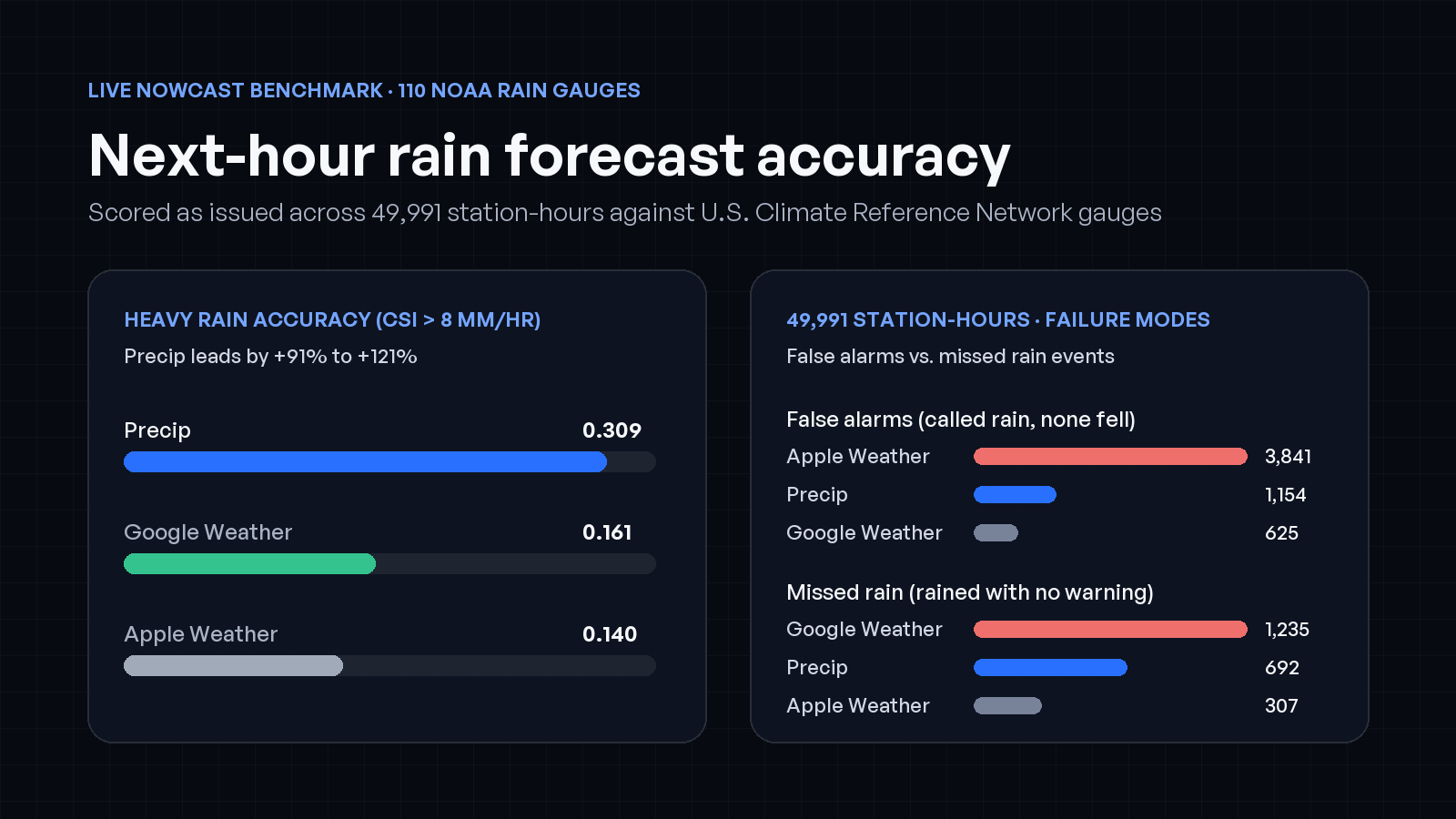
When we looked at 49,991 matched station-hours at 110 research-grade NOAA rain gauges between August 31 and October 12, 2026, the two default phone apps failed in opposite directions:
| Provider | False alarms (called rain, none fell) | Missed rain events (rained with no warning) | Heavy-rain accuracy (CSI > 8 mm/hr) |
|---|---|---|---|
| Precip | 1,154 | 692 | 0.309 |
| Apple Weather | 3,841 (3.3× more than Precip) | 307 | 0.140 |
| Google Weather | 625 | 1,235 (78% more than Precip) | 0.161 |
Apple Weather cries wolf. It called rain when the gauge stayed completely dry 3,841 times, more than three times as often as Precip. If you have ever gotten an iPhone notification saying rain is starting soon while looking up at a dry sky, that is why: raw radar reflectivity often picks up virga (rain evaporating before it reaches the ground) or light clutter and treats it as surface rain.
Google Weather lets you get drenched. It stays conservative to avoid false alarms, but in doing so it missed 1,235 actual hours of measurable rain at the gauge, 78% more missed rain events than Precip.
The rain that actually ruins plans
Light mist is an annoyance. Medium to heavy rain (over 0.31 inches per hour, or 8 mm/hr) is the rain that ruins a commute, floods a trench, or washes out a game.
It is also the hardest rain to forecast over the next 60 minutes, because convective cells grow, decay, and shift faster than standard models update.
To score rain events fairly, meteorologists use the Critical Success Index (CSI), which divides correct rain calls by the total of correct calls, missed rain, and false alarms:
Accuracy score (CSI) = correct calls / (correct calls + missed rain + false alarms)
A score of 1.000 is perfect. You cannot game CSI by calling rain all the time (false alarms drag your score down) or by rarely calling rain (misses drag your score down).
At NOAA’s climate reference rain gauges on medium to heavy rain (>8 mm/hr):
- Precip vs. Apple Weather: Precip scored 0.309 vs. Apple’s 0.140 (121% more accurate).
- Precip vs. Google Weather: Precip scored 0.309 vs. Google’s 0.161 (91% more accurate).
- Precip vs. Rainbow.ai: On matched hours, Precip scored 0.259 vs. Rainbow.ai’s 0.200 (29% more accurate).
Across all three independent ground-truth references (110 NOAA USCRN rain gauges, 5-minute NOAA MRMS Doppler radar, and gauge-adjusted hourly radar), Precip won 37 of 38 head-to-head tests and ranked #1 at every 5-minute step of the hour ahead from 5 minutes to 60 minutes.
Why Precip’s nowcast is more accurate
When we started Precip, our first product was a 1 km virtual rain gauge that fused NEXRAD dual-polarization radar with thousands of quality-controlled ground gauges to measure what actually reached the ground.
Most nowcasts simply advect (push forward) raw radar reflectivity blobs. Because Precip already runs a real-time observation pipeline that separates actual surface rainfall from radar noise, virga, and beam blockage, our in-house nowcast starts from a much cleaner 1 km picture of the storm and learns how storms evolve against gauge-calibrated ground truth.
We also tested our model on 16 major storms from 2024 (a held-out year the model never trained on, totaling 96 million 5-minute checks) against open research models including NVIDIA’s StormScope and three pySTEPS models. Precip beat every research model on every metric, scoring 39% higher on hourly heavy rain and 23% lower on 5-minute average error.
Check the numbers yourself
We publish the full tables, lead-time curves, and whitepaper on our live nowcast benchmark page, and we publish every real-time CONUS run of our 5-minute nowcast to a public Icechunk / Zarr v3 archive 24 hours after initialization so researchers can verify our scores independently.
If you want rain alerts on your Lock Screen that arrive before the first drop without crying wolf, download the Precip app on iPhone, Android, or the web, or integrate our nowcast into your own product via the Precip Weather API.